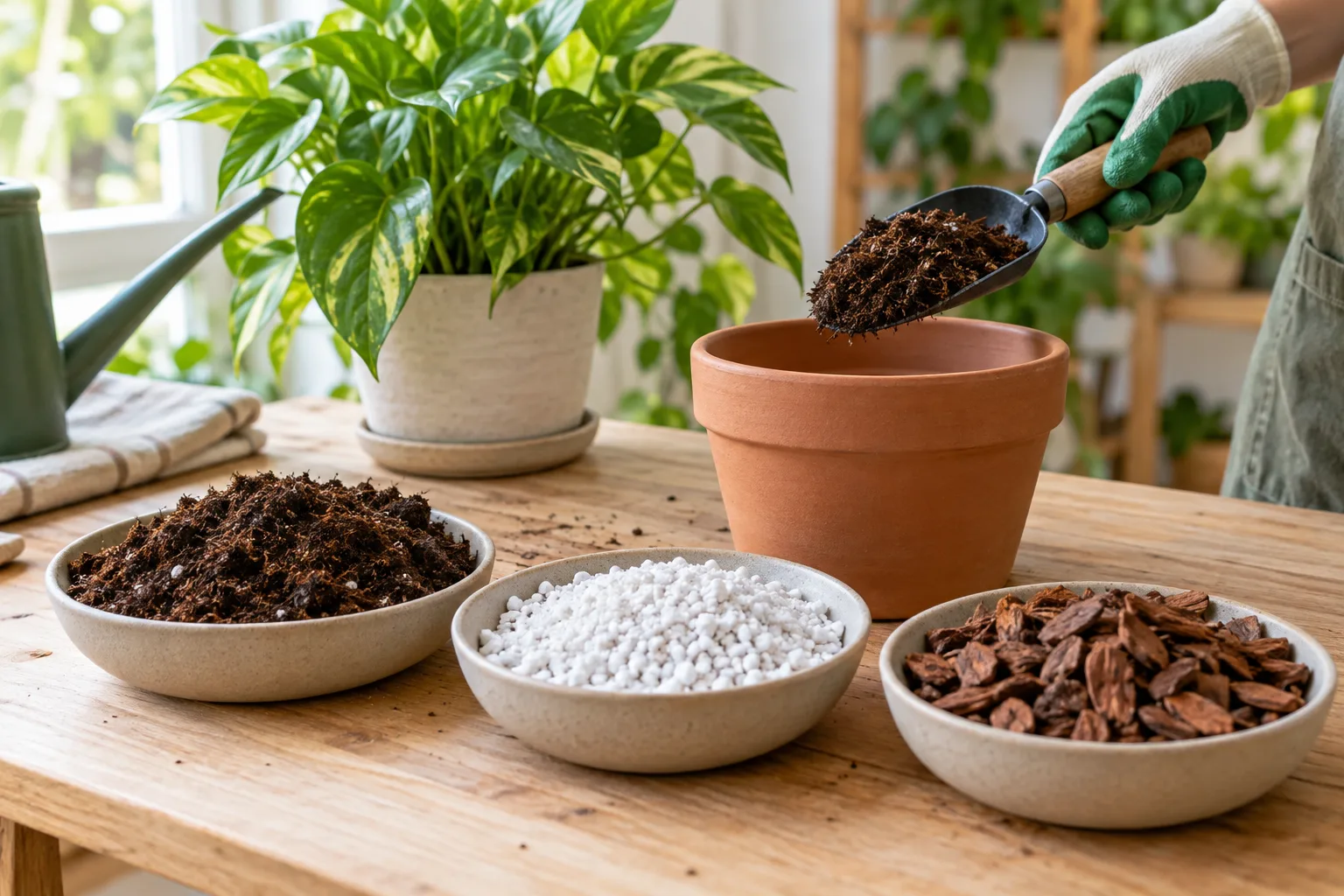
A suitable general houseplant mix can be a starting point for many foliage plants; succulents and many epiphytic orchids may need different media. Consider the mix, drainage holes, pot size and watering together.
What should a potting mix do?
Roots need water and air. A suitable container mix absorbs and holds some moisture while allowing excess to drain; pot size and material, light and temperature also affect how quickly it dries.
Commercial potting mixes may contain coir, peat, bark, perlite or vermiculite and do not necessarily contain ordinary garden soil. A product name alone does not reveal all its ingredients or nutrients.
Match the plant rather than using one fixed recipe
For many indoor foliage plants, start with a mix labeled for houseplants. Cacti and many succulents usually need a faster-draining mix, while epiphytic orchids such as Phalaenopsis often use a coarser orchid medium.
These are starting points, not rules for every species. Conditions and root health matter. Read the ingredients and directions even when the package says succulent or orchid.
Understand common ingredients and fertilizer labels
Coir and peat are often used to retain water; perlite can help create air space; bark is used in mixes needing a coarser structure. The result depends on particle size, proportion and the entire mixture.
Check whether slow-release or other fertilizer is already included before deciding what to add later. Follow the plant's growth and product directions to avoid doubling up. The cover illustrates materials and is not a recommended recipe.
Can garden soil go straight into a pot?
Unamended garden soil can compact and drain poorly in a small pot, and may introduce insects or pathogens indoors. A suitable commercial container mix is a practical starting point; this does not mean every formulated mix containing soil is unsuitable.
Very dry mix may resist water. Moisten it as directed before use and avoid raising dust. A layer of stones in the bottom cannot replace a drainage hole.
Check how the mix behaves after potting
Choose a suitably sized pot with clear drainage holes. Water according to the plant's needs, let excess drain and then observe whether the mix wets evenly, stays soggy or the plant continues to decline.
A healthy plant does not need frequent repotting just to chase a new recipe. If water runs straight down the side or the root zone stays wet, check roots, mix and container before deciding what to change.
Common questions
Can pothos, succulents and Phalaenopsis use the same mix?
Not necessarily. Foliage plants, succulents and epiphytic orchids can differ in moisture and structure needs; start with a mix intended for the plant type.
Does perlite guarantee good drainage?
No. Its proportion, the whole mix, drainage holes and pot size all influence drainage.
Should I fertilize newly purchased potting mix immediately?
Check whether fertilizer is already included, then consider the plant's growth and product instructions before adding more.
Can I use plain garden soil for an indoor plant?
Unamended garden soil is not recommended on its own: it can compact, drain poorly and bring pests or pathogens into a container.