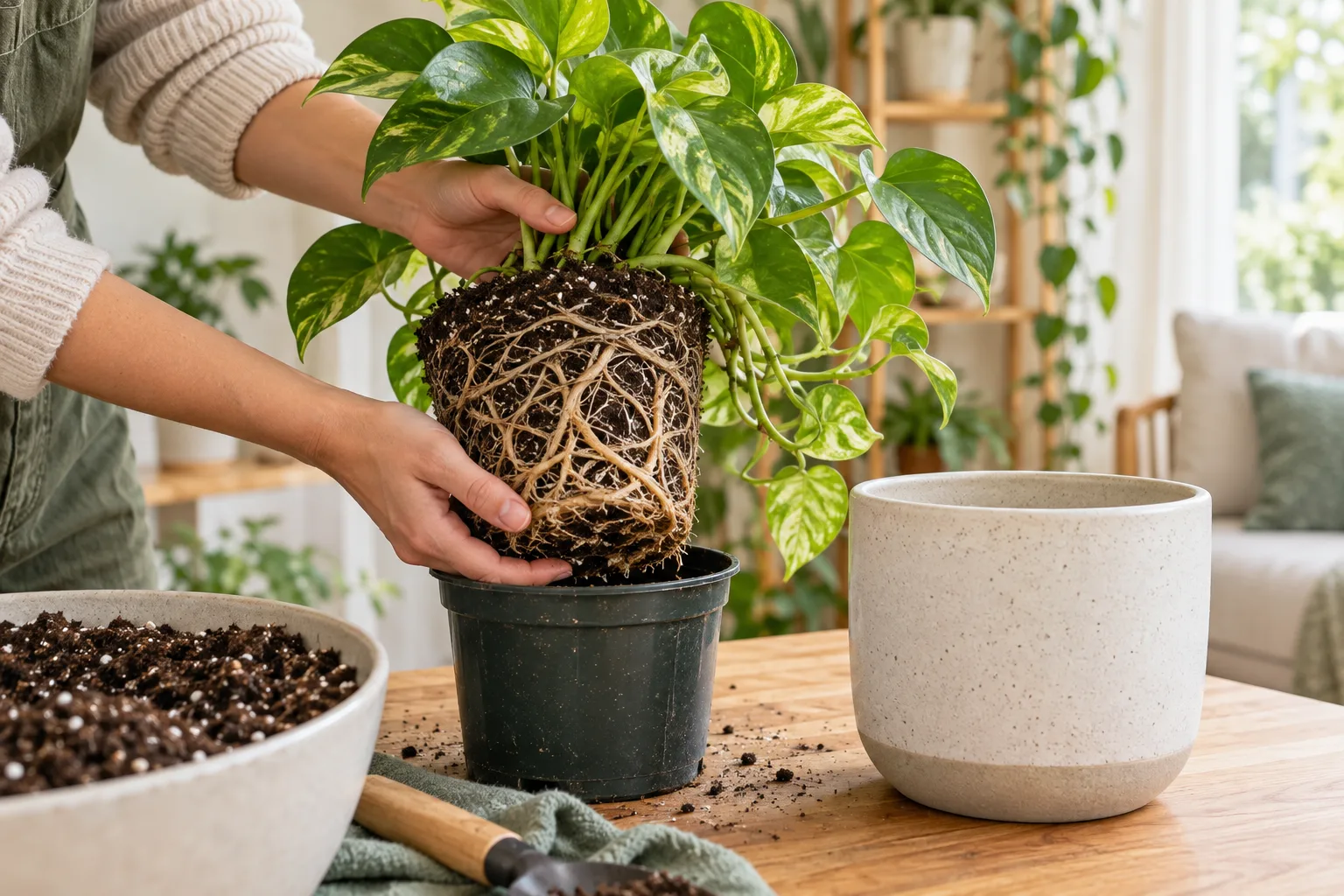
Tightly circling roots, substantial growth through drainage holes and unusually fast drying are reasons to inspect the root ball. If repotting is needed, choose a slightly larger draining pot and handle the roots gently.
Check the root ball, not just the size of the leaves
Mix drying much faster than usual, water running down the sides or many roots emerging from drainage holes are reasons to investigate, not proof on their own. Ease the plant out and look for tightly circling roots and how much mix remains.
A plant that tips easily, a broken pot or visibly worn-out mix can also call for attention. Yellow leaves have other possible causes, including watering and light; repotting is not a cure for every problem.
Choose the timing
For many common indoor foliage plants, the start of active growth in spring is a convenient time. The plant and local conditions matter. A broken pot or persistent waterlogging may need attention sooner.
A newly purchased plant that is stable can first adjust to its new home while you inspect it. There is no need to repot, prune the roots and fertilize all at once on arrival.
Choose a slightly larger draining pot
If more room is needed, choose a pot about one size larger. Too much extra mix can remain wet longer. Use a container with drainage holes and a mix suited to the plant.
When the roots are not crowded and only the old mix needs refreshing, the cleaned original pot may be suitable; a larger pot is not always necessary.
Lift, inspect and replant at the same depth
Prepare the pot and lightly moistened mix. Support the plant at its base and gently loosen the old container; do not pull hard on stems or leaves. Inspect the roots and ease apart circling roots at the outside without tearing the entire root ball.
Set the plant at roughly its previous depth, fill around it and firm lightly rather than packing the mix. Water according to the plant’s needs; for typical foliage plants, water after repotting and allow excess to drain.
Give the plant time to settle
Place it in the light appropriate for that species, avoiding a sudden move into harsh sun. Check the mix and new growth before watering again; do not repeatedly add water simply because it droops.
Do not rush to apply concentrated fertilizer to disturbed roots. Watch for recovery and follow the fertilizer and potting-mix directions. If wilting continues, recheck moisture and roots rather than just waiting.
Common questions
Must I repot when one root emerges from a hole?
Not necessarily. Check how crowded the root ball is, how quickly the mix dries and the plant’s overall condition.
Should I always water immediately after repotting?
Most common foliage plants benefit from watering the new mix and letting it drain, but succulents and other plants may need different handling.
Do I have to prune the roots?
Routine heavy root pruning is not necessary. Inspect and gently loosen circling roots, and distinguish rotten tissue from healthy roots.