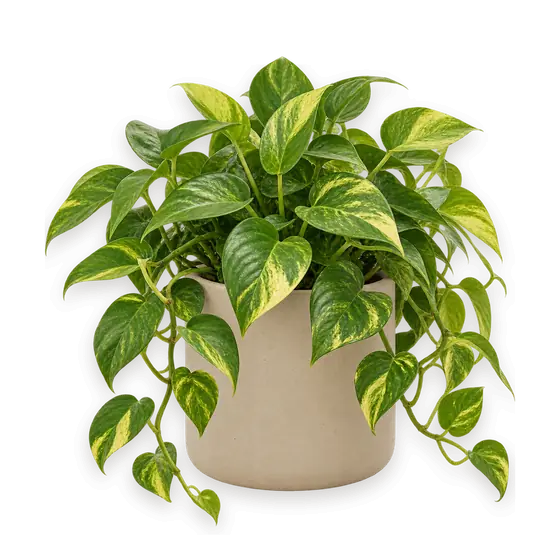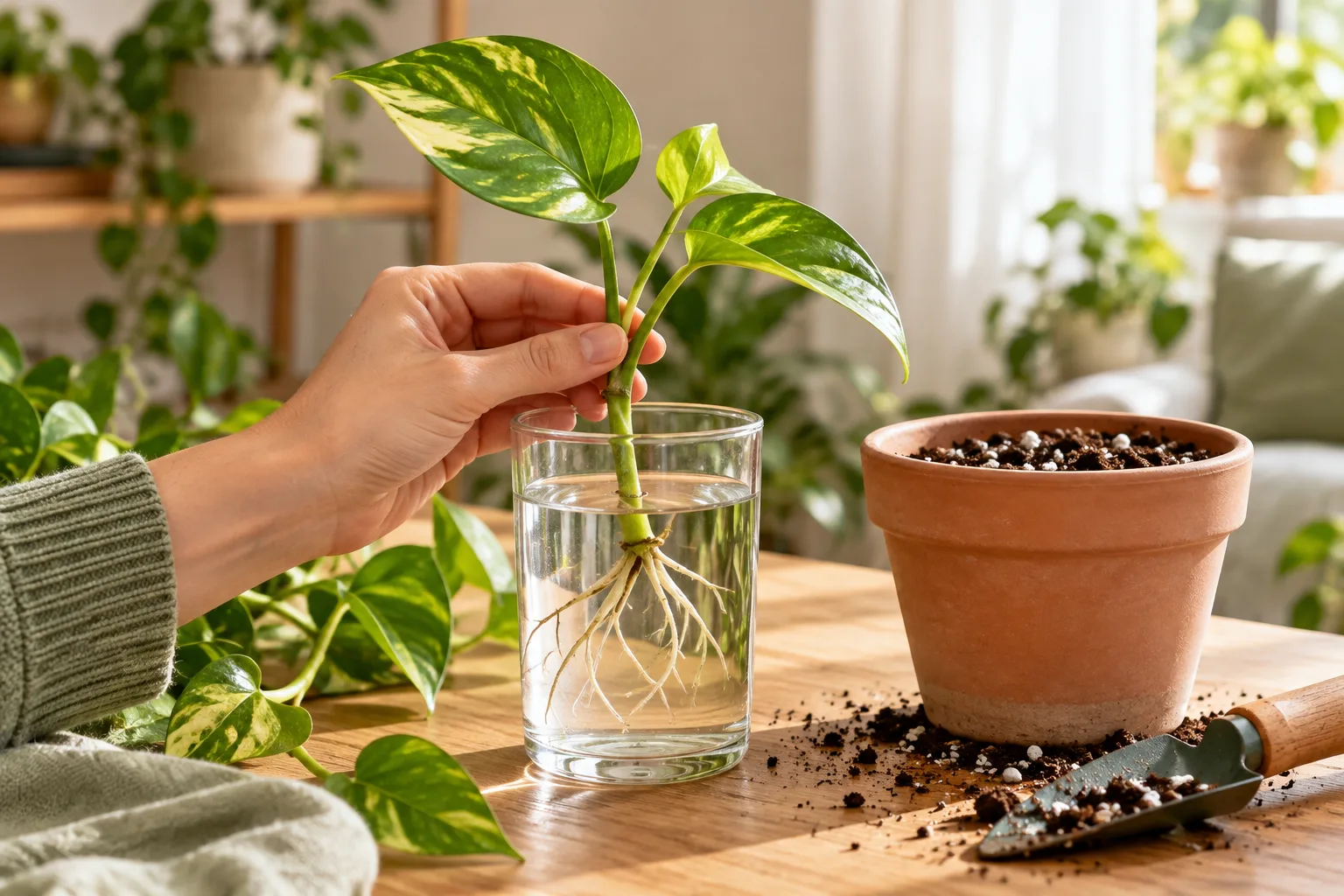
Choose a cutting with a healthy node and several roots. Place it in a small draining pot, gently fill with mix and water thoroughly. Keep the mix appropriately moist while it establishes, without leaving it waterlogged.
Check the node and roots
Pothos roots form near a stem node. Look for a healthy node and several firm roots. A leaf without a piece of stem containing a node generally cannot grow into a new pothos plant.
You can wait until roots are a few centimetres long and beginning to branch, but no exact length guarantees success. Water-grown roots are delicate and can be damaged when a dense mass is moved.
Prepare a small pot and airy mix
Choose a small pot appropriate for the cutting, with drainage holes, and a loose mix suited to indoor foliage plants. An oversized pot holds extra mix that can stay wet for longer.
Lightly moisten very dry mix before planting and use clean tools and containers. If roots are black, soft or smelly, investigate decay rather than treating clearly rotten roots as healthy.
Plant without breaking the water-grown roots
Make space in the mix, support the cutting and lower the roots in their natural direction without coiling or forcing them. Position the node at or just below the surface, with the leaves above the mix.
Fill gently around the cutting without compacting the mix. Water thoroughly once, let excess drain and empty the saucer.
Monitor moisture while it establishes
Keep the cutting warm in bright light away from harsh direct sun. Check the mix and keep it appropriately moist at first; avoid both letting the small root ball stay bone-dry and leaving the pot in standing water.
A water-rooted cutting can struggle during the transition, and success is not guaranteed. Watch for new roots and leaves. If yellowing or softness continues, check the mix and roots instead of trying to force growth with fertilizer.
Common questions
How long must water roots be before planting?
Several roots a few centimetres long with some branching are a reasonable point to try; no single length guarantees success.
Does a yellow leaf mean the transfer failed?
Not necessarily. Check whether the mix is too wet or dry and whether roots were damaged, then observe what happens next.
Should I fertilize immediately after transfer?
Let the cutting adjust and begin growing first, then follow the mix and fertilizer directions. Avoid concentrated feed to force rooting.