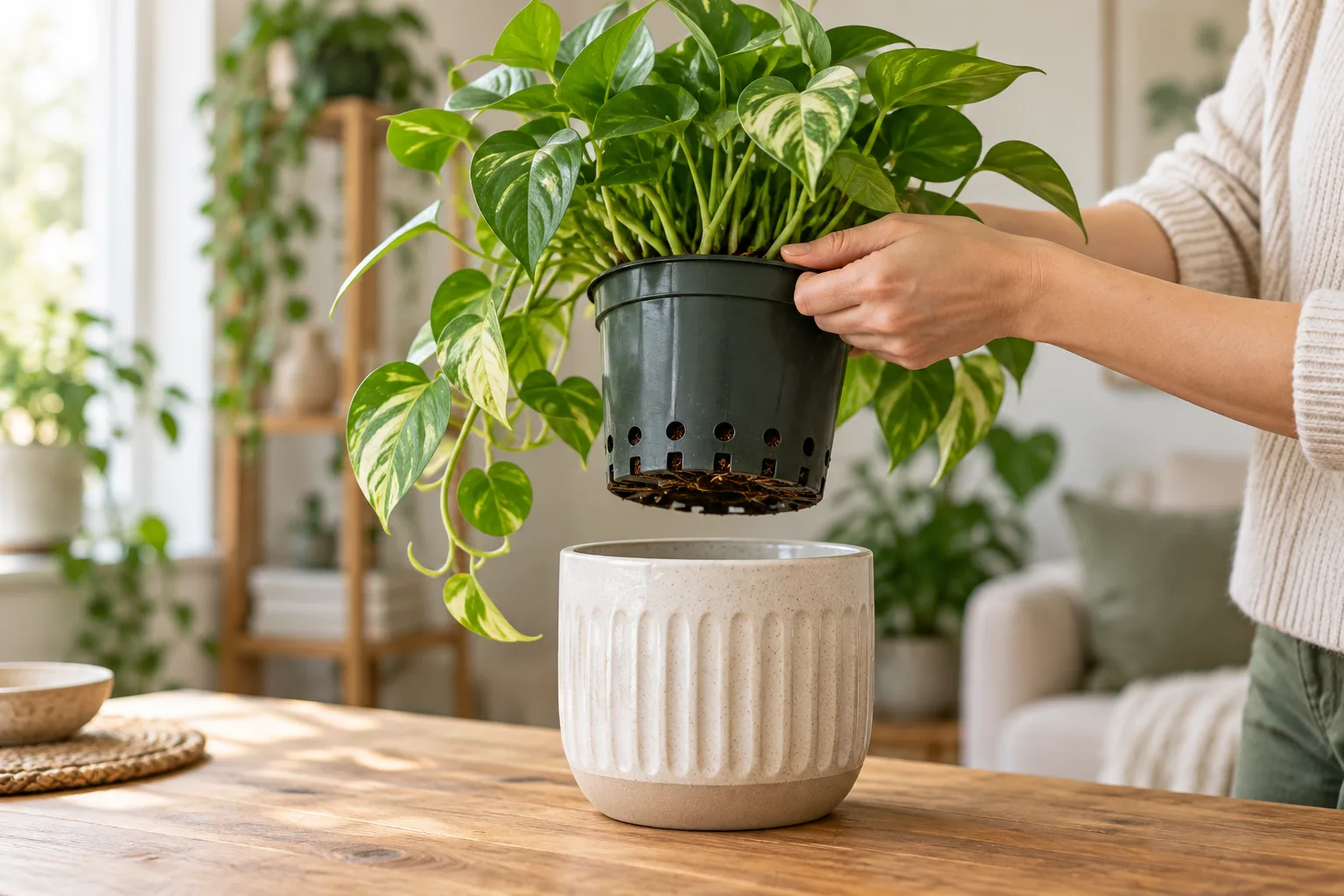
For ordinary soil-grown houseplants, use an inner pot with drainage holes. Remove it to water, let excess drain and empty the outer pot. A layer of stones is not a substitute for a hole.
Why is a solid-bottom pot harder to water?
Excess water has no exit, so the bottom of the mix can remain wet even after the surface dries. A small watering is not automatically safe: water can accumulate where you cannot easily see it.
This guide concerns ordinary soil-grown houseplants. Self-watering systems, water-grown plants and containers with engineered reservoirs work differently.
Use a draining inner pot and a cover pot
Choose a nursery or inner pot that fits inside the decorative pot, has drainage holes and suits the root ball. The plant stays in the inner pot; the outer container is decorative and catches any drips.
Take the inner pot to a sink or another place where it can drain. After watering, let it drain before returning it. Check the cover pot too, and do not leave the inner pot sitting in collected water.
Why stones do not replace a drainage hole
Stones take up space that roots and potting mix could use, while water still has no exit. University extension guidance notes that gravel at the bottom does not improve drainage and may raise the saturated layer.
If the plant is already growing directly in a solid-bottom pot, inspect both the plant and the mix. For ongoing care, consider transferring it to a draining inner pot at an appropriate time, protecting the roots as you move it.
Check before and after watering
Decide whether to water from the plant’s needs and the moisture inside the mix, rather than watering on a fixed schedule. Let excess water drain and empty both the saucer and cover pot.
If the inner pot is wedged in place, checking and emptying water becomes difficult. A better-fitting pair of pots is easier to manage than guessing how much water remains.
Common questions
Can I simply water less in a pot without holes?
Small waterings can still accumulate at the bottom and may not wet the root ball evenly. A draining inner pot is easier to manage.
Does expanded clay at the bottom fix drainage?
It does not replace an outlet. Water still has no way out, and the roots can remain too wet.
Does the same advice apply to self-watering pots?
Self-watering pots use a reservoir and different mechanisms. Follow the particular system’s instructions and the plant’s needs.