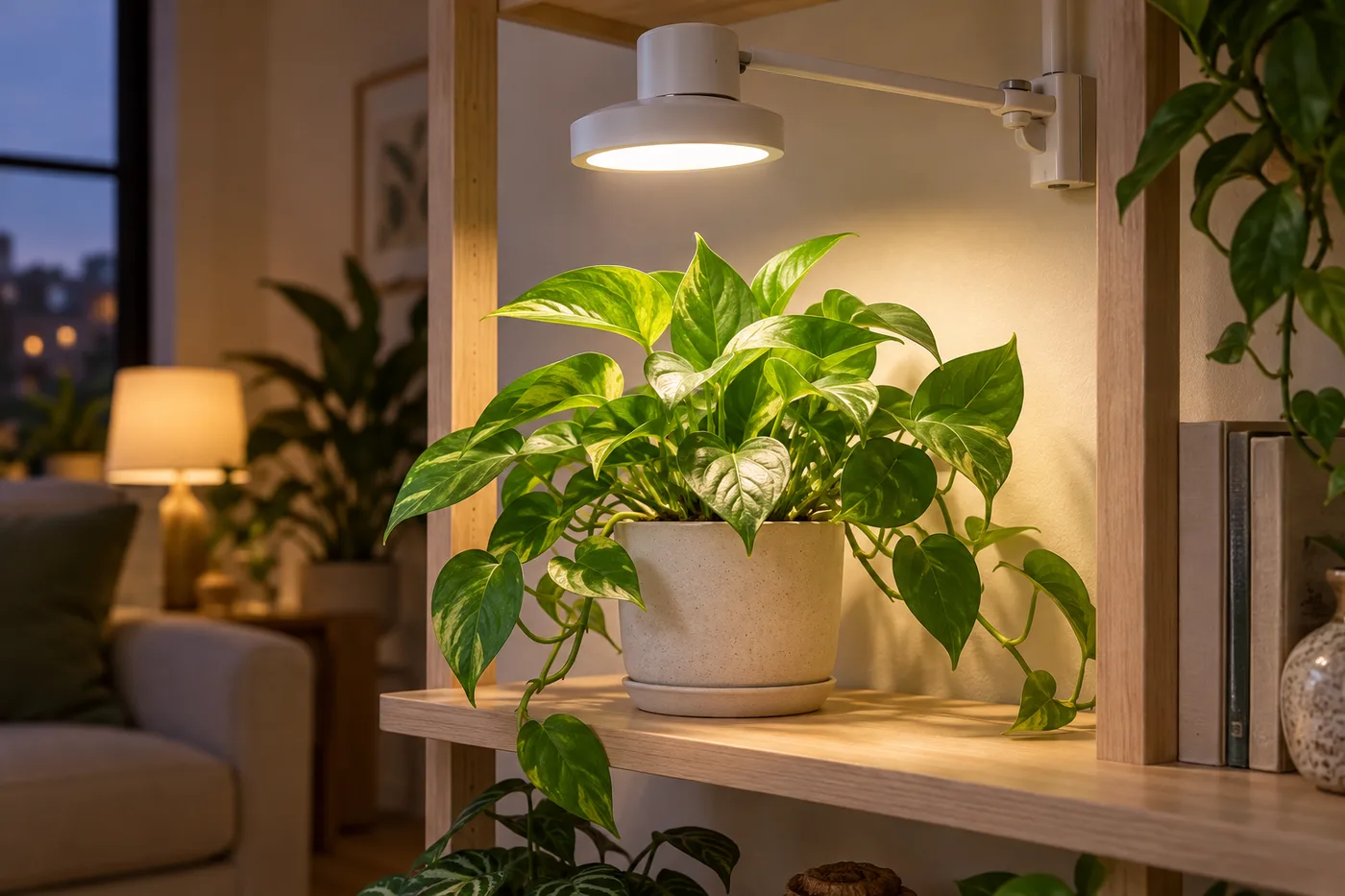
For many foliage houseplants, roughly 12–14 hours of total daily light is a starting reference, with a continuous dark period. About 12–24 inches (30–60 cm) from a small LED to the foliage is a common starting range, but follow the fixture's instructions and adjust for the plant and its response.
When should you consider a grow light?
First check whether the plant prefers bright indirect light or stronger light, then look at where it actually sits. Distance from a window, outdoor obstructions and shorter winter days can reduce the light reaching leaves. If practical, try a more suitable window position first; do not abruptly move a plant that prefers indirect light into harsh direct sun.
Longer gaps between new leaves, smaller new growth or a plant leaning strongly toward the window can be clues of insufficient light. Yellowing and slow growth can also have watering, root, temperature or pest causes, so one symptom is not a diagnosis.
What should you look for in a light?
For a small home setup, a white or full-spectrum LED intended for plants is a practical place to start. Look for coverage across the foliage, an adjustable height and a convenient timer. The light reaching the leaves and the area it covers matter more than a wattage number alone; watts mainly describe power use, not the amount of useful light reaching a plant.
A standard white LED fixture can also support plants when its output, distance and duration are suitable, but not every household lamp will provide enough light. Check the fixture's guidance; if light measurements are supplied at different distances, consider them alongside coverage and the plant's needs.
How far should the light be from the leaves?
University horticulture guides give roughly 12–24 inches (30–60 cm) from a typical small indoor LED fixture to foliage as a starting range. Fixtures differ greatly in output, lenses and coverage, so begin with the manufacturer's plant-specific instructions. A powerful lamp, seedlings or plants that prefer lower light may need a different distance.
Measure from the fixture to the highest leaves and leave room for new growth. Secure the light so it cannot touch the plant, and keep sockets, connections and the fixture away from watering and damp areas. The distance in the illustration is not measured or a universal recommendation.
How many hours a day—and when should it be dark?
The University of Minnesota suggests roughly 12–14 hours of total light per day for foliage houseplants. That includes useful natural light and lamp light; it does not mean automatically adding 12–14 hours after an already well-lit day. Where window light is weak, a timer can run the lamp consistently during the day, with adjustments for the plant and fixture.
Leave a continuous dark period each day rather than running the lamp all night. Plants such as holiday cacti and poinsettias can need specific day-and-night lengths to form flowers; follow care instructions for the particular plant and avoid interrupting its dark period when trying to encourage bloom.
How to adjust the setup
Over the following weeks, watch new leaves and stems. If new growth remains thin, stretched or pale, rule out other care problems and check whether the light is too distant or insufficient. If leaves nearest the lamp bleach or develop scorched patches, check for excessive light or heat, reduce exposure and consider other possible causes.
Change one factor at a time—distance, intensity or duration—and note the date before observing again. Old stretched stems generally do not shorten; look to subsequent growth for clues. Do not automatically water on a fixed schedule just because a lamp is on; check the potting mix and the plant's needs.
Common questions
Can an ordinary LED lamp work as a grow light?
Sometimes. It depends on the useful light reaching the leaves, the spectrum, distance and duration. A lamp that looks bright to people may still be inadequate for a plant; a plant-specific fixture usually offers clearer setup guidance.
Must I leave a grow light on for exactly 12 hours?
No. About 12–14 hours of total light is a reference for many foliage plants, not a universal rule. Natural light, fixture strength and species matter; some flowering plants have specific day-and-night requirements.
Is a closer light or a longer day always better?
No. Excessive light or heat can damage leaves, and all-night lighting can disrupt flowering in some plants. Follow the fixture guidance, allow darkness and watch the plant's response.
Can I copy the distance shown in the illustration?
No. The generated cover illustrates the arrangement; it is not a measured setup or a safety specification for any fixture.
Keep exploring
 Pothos careSee everyday light and watering guidance for pothos.