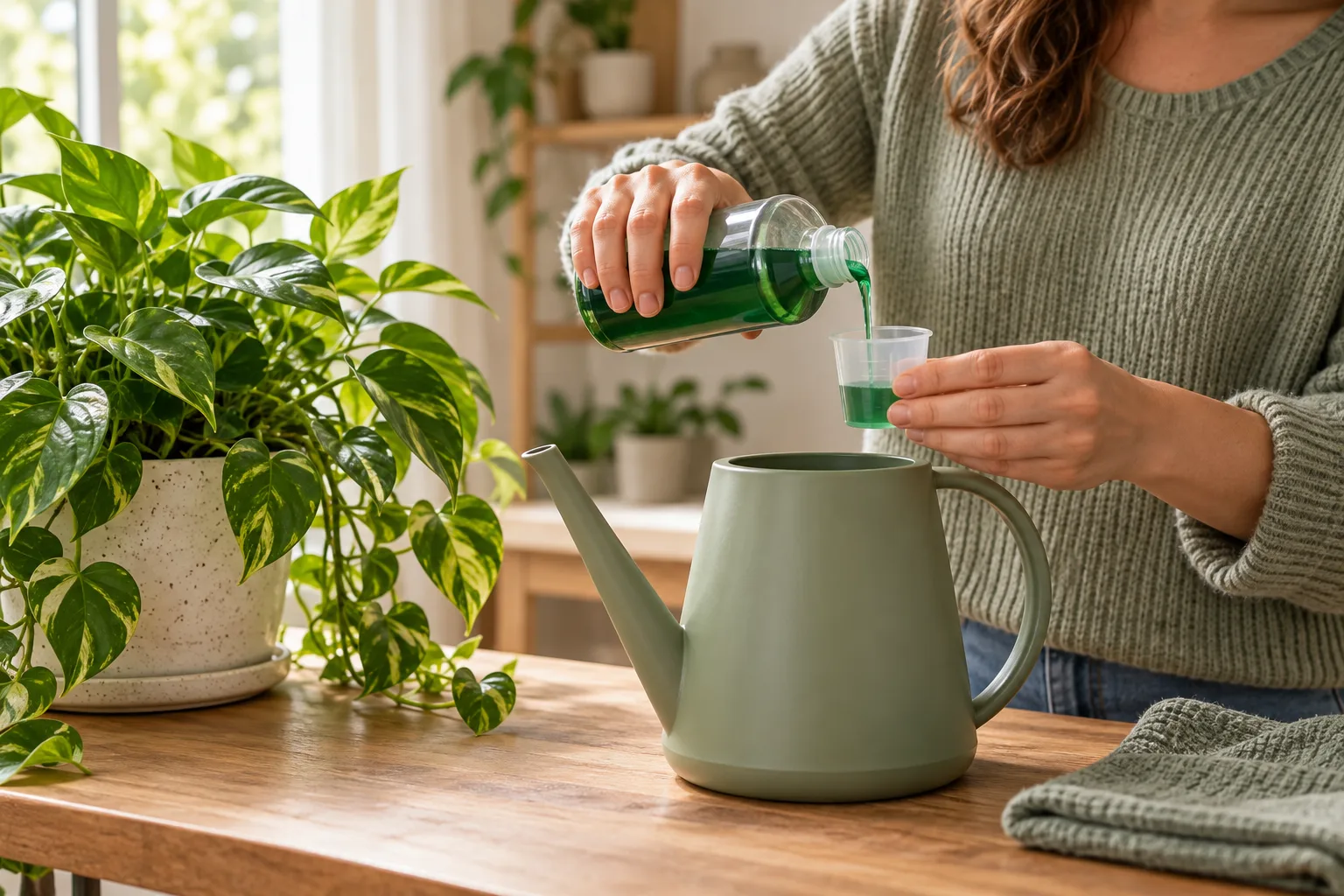
Choose a fertilizer suitable for houseplants and follow its label for dilution and frequency. Be cautious with slow-growing plants, damaged roots or mix that already contains slow-release feed. Stop feeding if excess fertilizer is suspected.
Start with the plant’s growth
Look at new leaves, shoots and seasonal light. Many foliage plants need some nutrients during active growth and less when growth slows, but there is no universal weekly schedule.
Fresh potting mix may already contain fertilizer. Read its packaging, allow the plant to settle after repotting and avoid stacking multiple feeds.
Follow the product’s rate and frequency
Liquid, granular and slow-release feeds deliver nutrients differently. Choose a product labelled for the plant and measure and dilute it as directed. Faster growth is not a reason to increase the concentration beyond the label.
A label may give different strengths for different schedules. Do not use a monthly concentration at every watering.
Check roots and mix before feeding
If the plant is wilted, roots are rotting or the mix stays waterlogged, investigate the cause rather than attempting to fix it with concentrated feed. Do not blindly apply strong fertilizer to very dry mix; follow the product and plant guidance.
Appropriate watering and good drainage help limit soluble-salt accumulation. Do not leave the pot sitting in water after feeding.
Pause if overfeeding is suspected
Brown leaf margins or white deposits on the mix or pot can be associated with salt buildup, but they have other possible causes too. Review recent fertilizer products, dilution, frequency and watering.
Stop feeding. For a plant that tolerates thorough watering in a draining pot, local horticultural guidance may recommend slowly flushing the mix with clean water and letting it drain. For severe damage, poor drainage or uncertainty, seek advice and inspect the roots.
Common questions
Do houseplants need fertilizer every week?
There is no universal schedule. Consider growth, any fertilizer already in the mix and the product’s labelled rate and frequency.
Do yellow leaves always mean a nutrient deficiency?
No. Light, watering, roots and natural ageing can affect leaves. Investigate before adding fertilizer.
Should I fertilize immediately after repotting?
Not necessarily. The new mix may already contain fertilizer; check its packaging and let the plant settle.